Key Takeaways
- FireSmart landscaping in the BC Interior isn’t about a bare, utilitarian yard — it’s about choosing the right plants and layouts that are both fire-resistant and genuinely attractive.
- The first 10 metres around your home (your “Home Ignition Zone”) is where your landscaping decisions matter most.
- Many common BC Interior garden favourites — including juniper, spruce, and ornamental grasses — are among the highest wildfire risks you can plant near your house.
- Non-combustible ground covers, strategic spacing, and moisture-retaining hardscape elements work together to slow fire spread dramatically.
- A professionally designed FireSmart yard can actually increase your property’s curb appeal and resale value — not reduce it.
If you live in the BC Interior — Kamloops, Merritt, Vernon, Barriere, or anywhere along that dry Interior corridor — wildfire isn’t a distant possibility. It’s a seasonal reality. The summers here are hot, the vegetation dries out fast, and fire can move through a neighbourhood faster than most people expect. What your yard looks like in June and July can genuinely affect whether your home survives an ember storm.
But here’s the thing we hear a lot from homeowners: “I don’t want my yard to look like a parking lot.” That’s fair. And it doesn’t have to. FireSmart landscaping in the BC Interior has come a long way from the “gravel and nothing” approach. Done well, it can produce a yard that’s layered, lush-looking, drought-tolerant, and genuinely beautiful — while dramatically reducing your home’s ignition risk. Let’s get into how it actually works.
Understanding the Home Ignition Zone (And Why the First 10 Metres Are Everything)
FireSmart Canada divides your property into zones based on distance from your home. Zone 1 is 0–10 metres from your foundation. This is where your landscaping choices have the biggest impact — and where most BC Interior homeowners are unknowingly creating serious fire risk without realizing it.
Embers carried by wind are the leading cause of home ignition during wildfires. They land in your garden beds, your wood chip mulch, your dried-out ornamental grasses, and your bark-filled planters. From there, fire doesn’t need to climb a hillside to reach your house — it’s already there.
In Zone 1, the FireSmart guidelines recommend keeping plants low-growing, well-spaced, and consistently irrigated. Ground-level plants should be separated from taller shrubs, and taller shrubs should be kept well away from your eaves, deck edges, and fence lines. Think of it as interrupting the ladder — if fire can’t climb from ground level to mid-height to your roofline, you’ve broken its path.
We’ve assessed properties in Kamloops where the entire Zone 1 was planted with mature junipers right up against the foundation. That’s one of the most common — and most dangerous — combinations we see. Juniper is highly resinous, holds dead material inside its canopy, and once it ignites, it burns intensely. Replacing it with something like Calamagrostis acutiflora ‘Karl Foerster’ (kept trimmed and well-watered) or low-growing Sedum varieties changes everything.
For more on what a professional landscape assessment and design process actually involves, see our post on what a landscape designer does — it explains how we approach site-specific planning from the ground up.
The Plants That Are Working Against You (And What to Use Instead)
Let’s be direct: some of the most popular landscaping plants in the BC Interior are genuinely bad choices for fire risk. We’re not saying they’re bad plants — some of them are beautiful. But if you’re planting them in Zone 1 or Zone 2, you’re increasing your exposure.
High-risk plants common in BC Interior yards:
- Juniper (all species) — resinous, holds dead material, ignites easily
- Blue spruce and other conifers near the home — ladder fuel risk, especially when mature
- Ornamental grasses left uncut through summer — dry grass is essentially kindling
- Wood chip or bark mulch in Zone 1 — highly combustible, especially in Kamloops-area heat
- Arborvitae hedges along fences — a continuous fuel path right to your home
Better choices for BC Interior FireSmart landscaping:
- Kinnikinnick (Arctostaphylos uva-ursi) — native, low-growing, excellent ground cover
- Salvia nemorosa (Balkan clary sage) — drought-tolerant, low fuel load, pollinators love it
- Potentilla fruticosa (shrubby cinquefoil) — hardy, low-growing, native to BC, great for Zone 2
- Festuca glauca (blue fescue) — kept small and trimmed, much lower risk than tall ornamental grasses
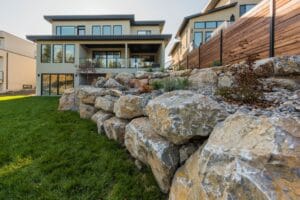
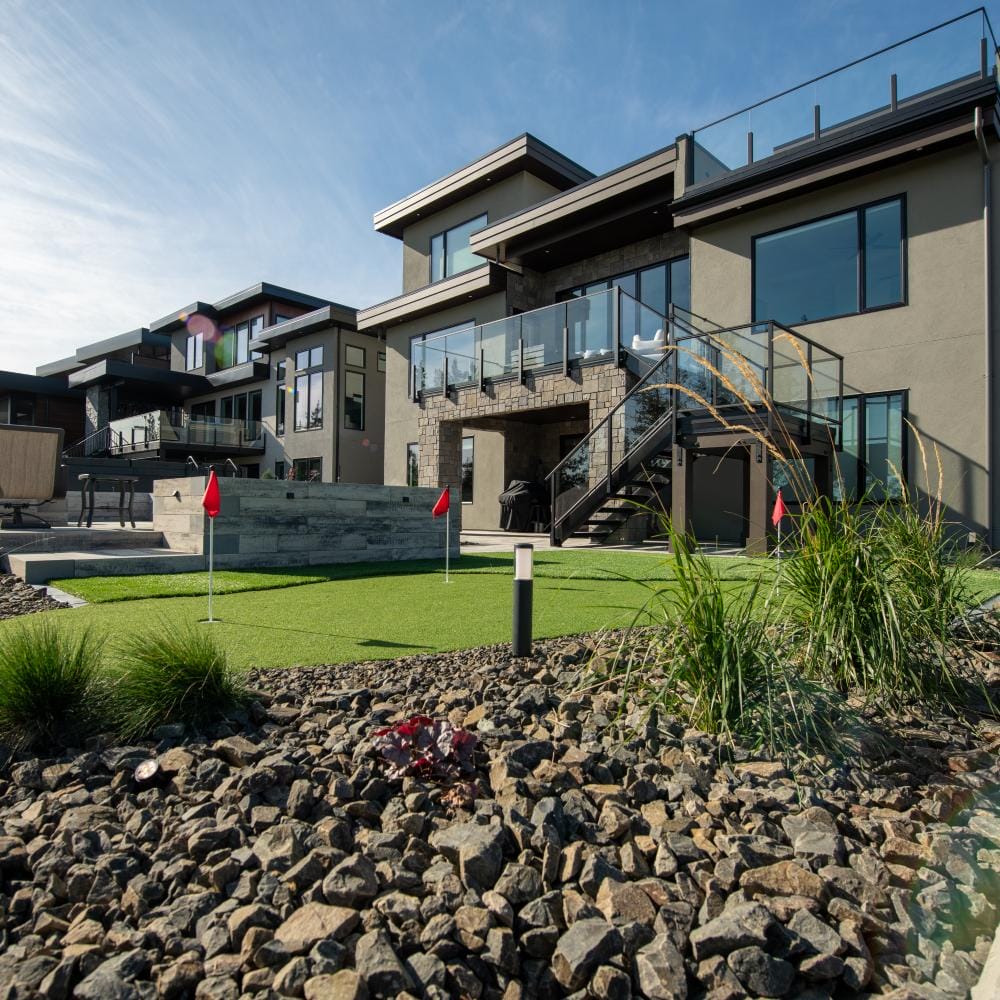
- Rock mulch or crushed gravel in Zone 1 — non-combustible, retains moisture, looks sharp
The goal isn’t to eliminate plants — it’s to choose ones that don’t carry fire and that you can keep maintained. A dry, overgrown yard is always more dangerous than a well-maintained one, regardless of species.
According to FireSmart Canada, using non-combustible landscaping materials, maintaining a 1.5-metre non-combustible perimeter around the home, and choosing well-spaced, fire-resistant plants can help reduce wildfire ignition risk.
How Hardscaping Fits Into a FireSmart Design
This is where FireSmart landscaping actually gets interesting from a design perspective — because hardscape elements aren’t just practical, they’re beautiful, and they serve a genuine fire-resistant function.
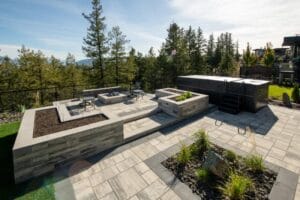
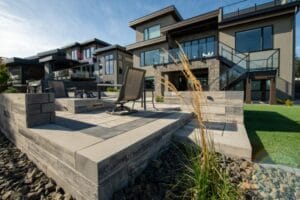
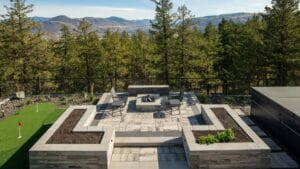
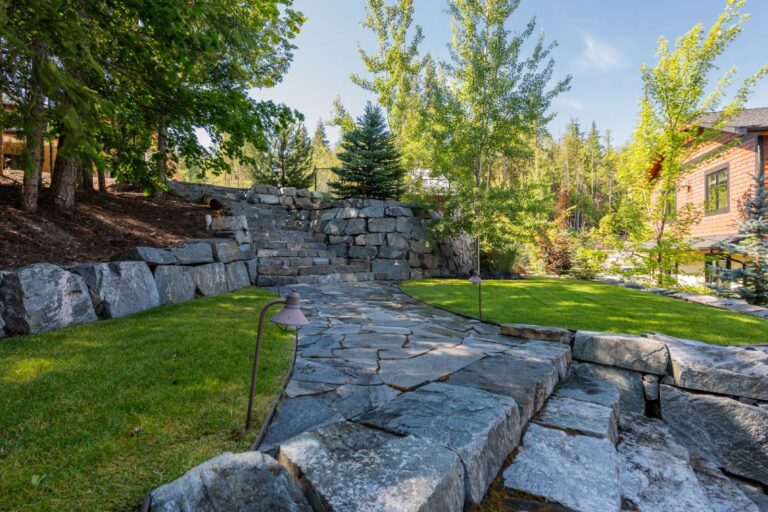
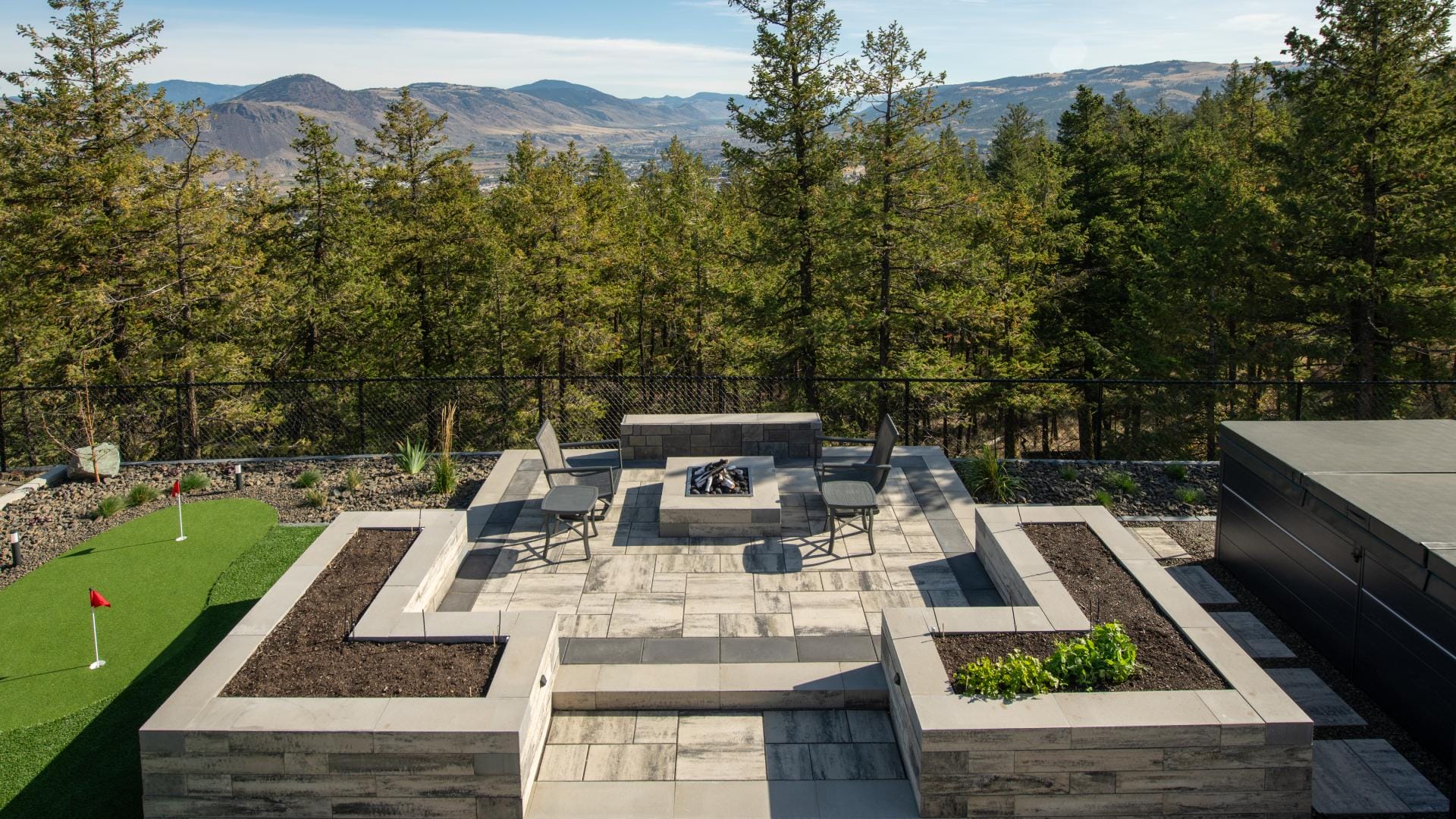
Stone pathways, gravel borders, concrete or paver patios, and rock garden beds all act as natural firebreaks. They interrupt the fuel path. A wide flagstone patio that wraps around your home’s south and west sides (typically the most exposed faces in the BC Interior) creates a non-combustible buffer that looks intentional, not defensive.
We worked on a residential property in the Kamloops area where the homeowner wanted a full backyard renovation after a wildfire came within a few kilometres of their neighbourhood. They were understandably shaken. The design solution wasn’t to strip the yard bare — it was to replace the wood chip beds with a crushed granite ground plane, install a large natural stone patio off the back deck, create a raised rock garden with drought-tolerant natives, and push the conifer trees to the outer edge of the property (Zone 3), well away from the structure. The result looked intentional, modern, and distinctly BC Interior. The homeowner told us it looked better than what they’d had before.
That’s the honest truth about FireSmart design: it often forces better decisions. You end up with a more cohesive, lower-maintenance yard because you can’t rely on dense evergreen shrubs as a quick visual filler.
Our residential landscaping services include hardscape design and installation that can be fully integrated with a FireSmart plan — including patios, stone borders, and non-combustible ground treatments that meet FireSmart Zone 1 guidelines.
Maintenance Is Half the Battle — Especially in a BC Interior Summer
Here’s something that doesn’t get said enough: you can design the most thoughtful FireSmart yard imaginable, and it won’t matter much if you don’t maintain it through the summer. By mid-July in Kamloops, a yard that looked green and managed in May can be completely dried out. Dead plant material accumulates fast, and fire doesn’t care whether your yard was FireSmart in spring if it’s a tinderbox in August.
FireSmart maintenance in the BC Interior means:
- Trimming ornamental grasses and perennials regularly through July and August
- Clearing dead leaves, debris, and bark material from Zone 1 at least twice during fire season
- Keeping a 1.5–2 metre clearance between shrub canopies in Zone 1
- Removing dead lower branches from any trees within 10 metres of your home
- Checking and maintaining drip irrigation to keep Zone 1 plantings hydrated
Irrigation is especially important here. A well-irrigated Zone 1 doesn’t just keep your plants healthy — it genuinely reduces ignitability. Dry soil and dry plants burn; moist ones resist. If your current irrigation setup doesn’t cover your Zone 1 beds consistently, that’s worth addressing before next fire season.
If staying on top of seasonal maintenance feels like a lot — it is — our team provides ongoing landscape maintenance services across Kamloops and the BC Interior, including fire season property checks and vegetation management. It’s one of those services that’s easy to undervalue until you actually need it.
Getting a FireSmart Assessment: What to Expect and Where to Start
The Province of BC, in partnership with FireSmart Canada, offers free home assessments through local fire departments and community FireSmart representatives. If you haven’t had one done, it’s worth doing before you invest in any significant landscaping work. An assessment will walk through your property zone by zone and identify specific risks — which gives you a much better foundation for a design conversation with a landscaper.
The BC Wildfire Service’s FireSmart resources include a homeowner manual, assessment tools, and a list of recognized local programs. It’s a genuinely useful starting point before you make any plant or hardscape decisions.
Once you have your assessment, bring it to your landscaping consultation. A good landscape designer can translate those zone-by-zone recommendations into an actual design — something that looks cohesive and functions well, not just a checklist of things to remove. That’s the gap between a FireSmart yard that feels punitive and one that you’re actually proud of.
We’ve helped homeowners throughout the BC Interior take assessment results and build complete yard redesigns around them. The properties that come out the other side tend to be lower-maintenance, more drought-adapted, and — genuinely — more visually interesting than the conventional pine-and-juniper plantings they replaced.
If you’re not sure where to start or what questions to bring to your first consultation, our post on 10 questions to ask before hiring a landscaper is a useful read — it’ll help you walk into that conversation informed.
Conclusion: A Safer Yard Doesn’t Have to Look Like a Safety Precaution
FireSmart landscaping in the BC Interior isn’t about sacrifice. It’s about making smarter choices — ones that work with this climate instead of against it. The plants and materials that perform best in Kamloops summers are largely the same ones that happen to be fire-resistant: drought-adapted, low-growing, well-spaced, and manageable. That’s not a coincidence. It’s good design.
If you’re ready to take a serious look at your yard’s fire risk — or if you just want to redesign your outdoor space in a way that makes sense for where you actually live — we’d love to help. Lyons Landscaping has worked on properties across the BC Interior, and we bring a practical, site-specific approach to every project.
Contact Lyons Landscaping today to discuss your FireSmart landscaping project. We offer consultations for residential properties across Kamloops and the BC Interior, and we can help you design a yard that looks great and gives you real peace of mind when fire season rolls around.