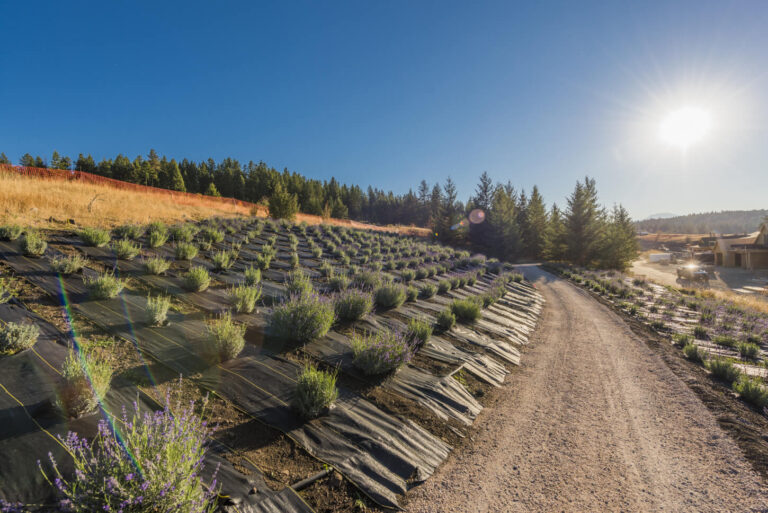
Designing a Low Maintenance Landscape for BC Interior Acreages and Large Properties
Key Takeaways
- Low maintenance landscaping in BC’s Interior starts with zoning your property — not every square metre needs the same level of care.
- Plant selection matters more than almost anything else. Native and climate-adapted species dramatically cut your water, labour, and replacement costs.
- A well-designed irrigation system pays for itself within two to three seasons on a large Interior property.
- Hardscaping and mulch are your best long-term allies against weeds, erosion, and that relentless summer heat.
- The biggest mistake we see on acreages is trying to maintain too much lawn. Reducing turf is the single fastest way to reduce your workload.
Introduction
If you own an acreage or large property in the BC Interior, you already know the challenge: the landscape you imagined when you moved in quickly becomes the landscape that owns your weekends. Low maintenance landscaping in BC’s Interior isn’t about doing less — it’s about designing smarter from the start, so the land works with you instead of against you. The Interior’s climate is unforgiving in ways that most gardening advice from the coast or from Ontario simply doesn’t account for. You’re dealing with 35°C summers, hard frosts into May, alkaline soils, and the kind of drying wind that can wilt a poorly-chosen plant in under a week.
At Lyons Landscaping, we’ve worked on properties across Kamloops, the Thompson-Okanagan, and throughout the BC Interior for years. We’ve seen what works on a 10-acre hobby farm outside Kamloops, and we’ve seen what doesn’t work on a beautifully designed estate that nobody can actually maintain. This post goes deep on one thing: how to design a large property so that it genuinely stays manageable season after season — without sacrificing how it looks.
Zone Your Property Before You Plant a Single Thing
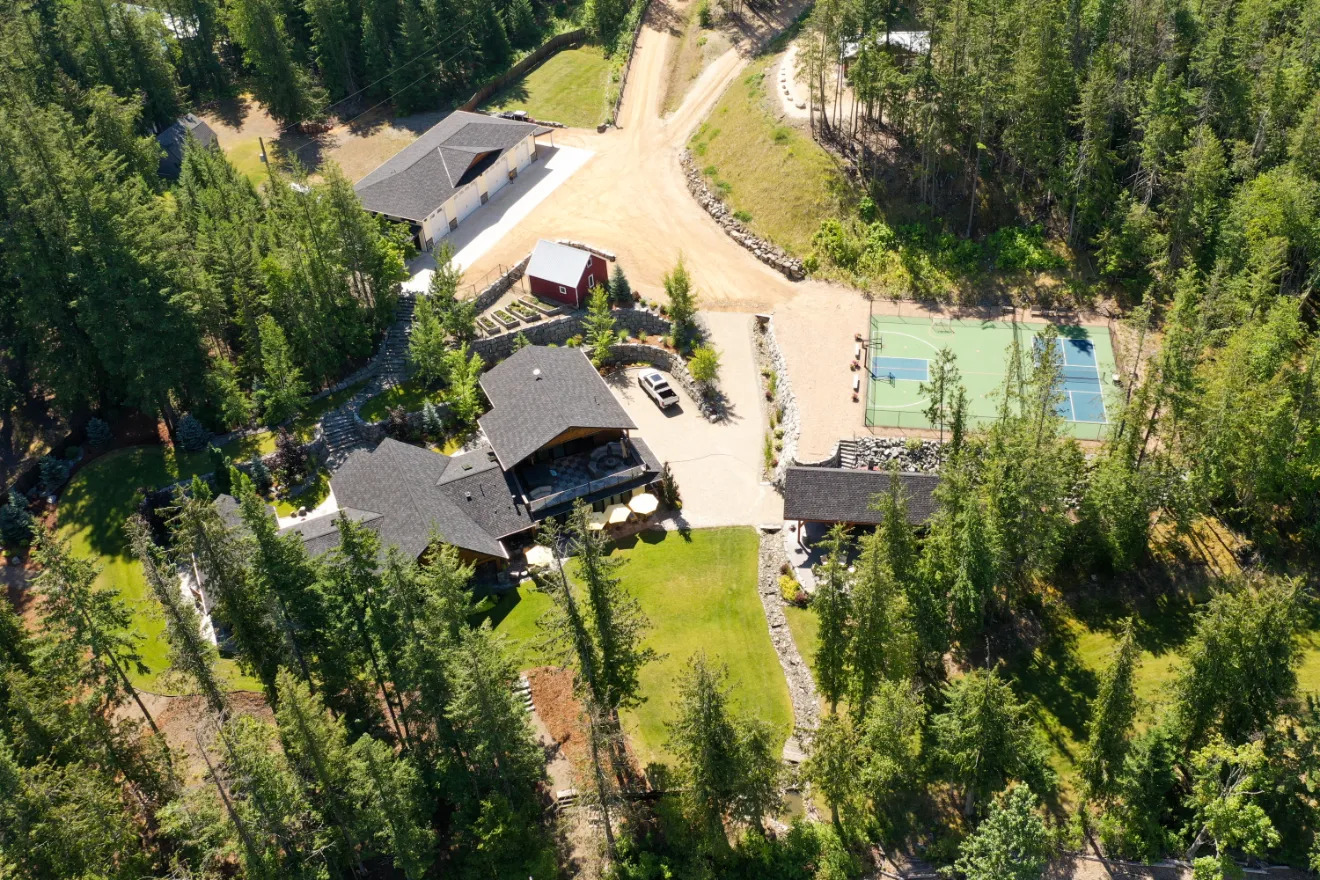
This is the piece of advice we give every acreage owner, and it’s the one most people skip because they’re eager to get started. Before you choose plants, paving, or anything else, divide your property into management zones based on how much time and water you’re actually willing to spend.
A practical zoning framework for a large BC Interior property might look like this:
- Zone 1 — High care (immediately around the home): This is where you invest in gardens, defined planting beds, and lawn if you want it. Keep this zone tight — maybe 20 to 30 metres from the house, maximum.
- Zone 2 — Moderate care (transitions and outbuildings): Native shrubs, ornamental grasses, groundcovers, and mulched pathways. These areas look intentional but ask very little of you once established.
- Zone 3 — Low/no care (fields, slopes, and boundaries): Naturalized plantings, meadow grasses, or simply managed native growth. On a wildfire-interface property, this zone also needs to align with BC’s FireSmart guidelines, which have real implications for what you plant and where.
We worked with a client near Monte Creek who had five acres and was mowing the entire thing every two weeks. Once we rezoned the property — keeping a half-acre around the house as a managed landscape and converting the rest to native bunch grasses and drought-tolerant shrubs — their weekly maintenance time dropped by more than half. That’s the power of zoning before you design.
Plant Selection: The Interior Is Not the Coast, and Generic Lists Will Let You Down
Let’s be blunt about something. Most “low maintenance plant” lists you’ll find online are written for USDA zones 6 and 7, Pacific coastal climates, or somewhere in the American Midwest. They’re not written for Kamloops, where you might see -25°C in January and +38°C in July, where the soil is often alkaline and compacted, and where summer rainfall is essentially a rumour.
For low-maintenance success on a BC Interior acreage, lean hard into these plant categories:
- Native shrubs: Saskatoon berry (Amelanchier alnifolia), red-osier dogwood (Cornus sericea), and rabbitbrush (Ericameria nauseosa) are workhorses. Once established, they need almost no supplemental water and provide wildlife habitat as a bonus.
- Ornamental grasses: Blue oat grass (Helictotrichon sempervirens) and feather reed grass (Calamagrostis x acutiflora ‘Karl Foerster’) handle Interior summers with ease and look incredible year-round.
- Drought-tolerant perennials: Yarrow (Achillea millefolium), Russian sage (Perovskia atriplicifolia), and catmint (Nepeta x faassenii) are proven performers across our Interior projects.
- Hardy trees: Trembling aspen (Populus tremuloides) for naturalized zones, and disease-resistant crabapple cultivars near the home for structure and four-season interest.
A word of caution: avoid planting anything from the invasive species list for BC’s Interior. Japanese knotweed, purple loosestrife, and Siberian elm are all still being planted by well-meaning homeowners who don’t realize the problem they’re creating. Check the BC Invasive Species Council’s identification resources before you buy anything unfamiliar.
If you want expert plant selection guidance tailored to your specific property, our Kamloops Garden Centre stocks hardy trees, shrubs, and perennials selected specifically for Interior growing conditions — not whatever was cheapest to ship from a Lower Mainland wholesaler.
Irrigation: The Investment That Actually Saves You Money
Here’s an opinion we’ll stand behind firmly: on any large BC Interior property, a professionally designed drip irrigation or zone-based sprinkler system is not a luxury. It’s the foundation of a low-maintenance landscape. Full stop.
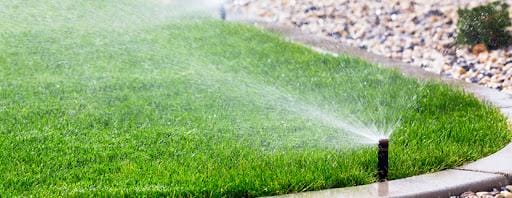
Hand-watering an acreage is a part-time job. Overhead sprinklers running on a timer waste enormous amounts of water to evaporation in Interior heat and often water the wrong things — including your weeds. A drip or micro-irrigation system delivers water directly to the root zone of your plants, dramatically reduces evaporation loss, and can be automated with moisture sensors so it only runs when the soil actually needs it.
The City of Kamloops and many other Interior municipalities have tiered water pricing structures that make overwatering genuinely expensive. A properly designed system typically pays for itself within two to three seasons through water savings alone — and that’s before you factor in the time you’re not spending dragging a hose around.
We design and install irrigation systems as part of our full landscape services package, and we also include irrigation maintenance and winterization through our ongoing property care programs. Getting your system properly blown out before freeze-up isn’t optional in the Interior — a burst line in March is an expensive lesson.
Hardscaping and Mulch: Your Best Weapons Against Weeds and Erosion
On large properties, the battle against weeds and erosion is ongoing. The good news is that smart hardscaping and a consistent mulch strategy can dramatically reduce both, and once they’re in place, they’re nearly self-maintaining. Leaning into hardscaping as a low-maintenance strategy — getting the balance of hard and soft elements right — is one of the most effective ways to cut ongoing upkeep on a large property.
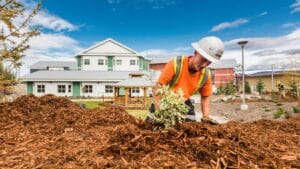
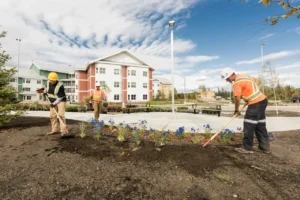
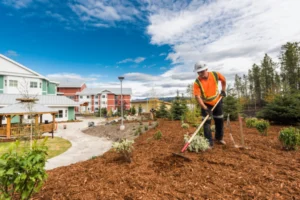
Mulch is underused on acreage properties, and it’s a mistake. A 3- to 4-inch layer of quality wood chip or shredded bark mulch in your planting beds does three critical things in the Interior: it holds soil moisture (vital when you’re getting 250–300mm of annual precipitation in some Interior valleys), suppresses weeds, and insulates roots against the wild temperature swings from shoulder-season frosts. We generally recommend refreshing mulch every two to three years, though this varies with decomposition rate and sun exposure.
Gravel and decomposed granite are excellent low-maintenance alternatives to lawn or bark mulch in hot, dry transition zones. They don’t decompose, don’t blow away in Interior wind events, and when installed over quality landscape fabric or a compacted base, keep weeds suppressed for years.
Defined hardscaping — patios, pathways, retaining walls — gives your landscape structure that holds up through freeze-thaw cycles and reduces the soft edges where weeds love to establish. On acreages with significant grade changes, retaining walls also prevent the kind of erosion that can turn a hillside planting bed into a mess after one good Interior thunderstorm. Our team handles everything from ongoing property maintenance to full hardscape builds, so if you’re not sure where to start, that’s a good place to look at what a full-service relationship actually includes.
Reduce Your Lawn — Seriously, Just Do It
We’ve said it before and we’ll keep saying it: lawn is the most maintenance-intensive surface on any large property. It needs mowing, edging, fertilizing, aerating, overseeding, and in the BC Interior, it needs significant irrigation from June through September to stay green. On an acreage, a large lawn area isn’t a feature — it’s a commitment.
We’re not suggesting you rip out every blade of grass. A well-maintained lawn around an outdoor living area looks beautiful and creates a usable space for kids, dogs, and summer evenings. But if you have sweeping lawns extending to field edges or down long driveways simply because that’s what was there when you moved in, ask yourself honestly whether you’re maintaining that turf or just managing guilt about not maintaining it. If you want to see a real low-maintenance conversion example, our write-up on one homeowner’s wildflower lawn shows exactly what replacing turf can look like in practice.
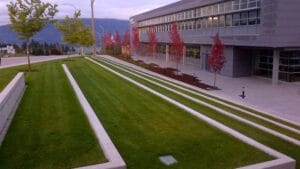
Replacing lawn with native groundcovers, ornamental grass meadows, or even clean gravel and rock mulch in lower-traffic zones is one of the highest-return decisions you can make for long-term low-maintenance landscaping in BC’s Interior. We’ve helped clients reduce their irrigated lawn area by 60 to 70 percent and end up with a property that actually looks more intentional and polished — not less.
For lower-traffic zones especially, a proven low-water approach for the same climate — xeriscaping paired with synthetic turf where it makes sense — takes lawn reduction a step further.
If you’re unsure whether a landscape designer could help you see those possibilities on your property, our post on what a landscape designer actually does is worth a read. Good design on a large property pays for itself many times over.
Conclusion
Designing a low-maintenance landscape for a BC Interior acreage or large property isn’t complicated, but it does require intention. Zone your property honestly, choose plants that are actually suited to Interior conditions, invest in irrigation, use hardscaping and mulch strategically, and be ruthless about reducing unnecessary lawn. Do those five things well, and you’ll have a property that looks great and respects your time — which is really the whole point.
If you’re ready to stop fighting your land and start enjoying it, Lyons Landscaping’s design team would be happy to walk your property and put together a plan that actually fits your life. Contact Lyons Landscaping today for a free estimate — we work with acreages and large properties throughout Kamloops and across the BC Interior, and we’d love to show you what’s possible.