
Key Takeaways
- A vague commercial landscaping scope of work in BC is one of the most common — and expensive — mistakes property owners and strata councils make.
- Your scope of work should define exactly what’s included, how often, and to what standard — seasonal BC conditions make this especially critical.
- Ambiguous language like “as needed” or “general maintenance” gives contractors wiggle room that almost always ends up costing you more money.
- BC Interior properties face unique seasonal pressures — dry summers, freeze-thaw cycles, and invasive species like knotweed — that must be addressed explicitly in any contract.
- A well-written scope protects both parties and makes it far easier to evaluate competing bids on equal terms.
Introduction: The Contract That Cost One Strata $14,000 in Surprises
We’ve seen it more than once. A strata council in Kamloops signs a one-page commercial landscaping agreement that says something like “lawn care and general property upkeep, April through October.” Sounds reasonable enough. Then July arrives, the ornamental trees along the entrance need pruning, a retaining wall irrigation head gets damaged by a mower, and the contractor says — correctly, according to the contract — that neither of those things was included. The strata ends up paying for emergency tree work and irrigation repairs out of operating reserves. Total damage? Close to $14,000 that could have been avoided with a clearly written commercial landscaping scope of work in BC.
This isn’t a horror story about bad contractors. It’s a story about a bad contract. Vague language is genuinely one of the most expensive things a property owner or manager can put in writing. If you’re responsible for a commercial property, a strata complex, a municipal facility, or an institutional site anywhere in BC — especially in the Interior where seasonal extremes are real — this guide will walk you through exactly what a solid scope of work looks like, what it needs to include, and how to use it to protect your budget year after year.
What a Scope of Work Actually Is (And What It’s Not)
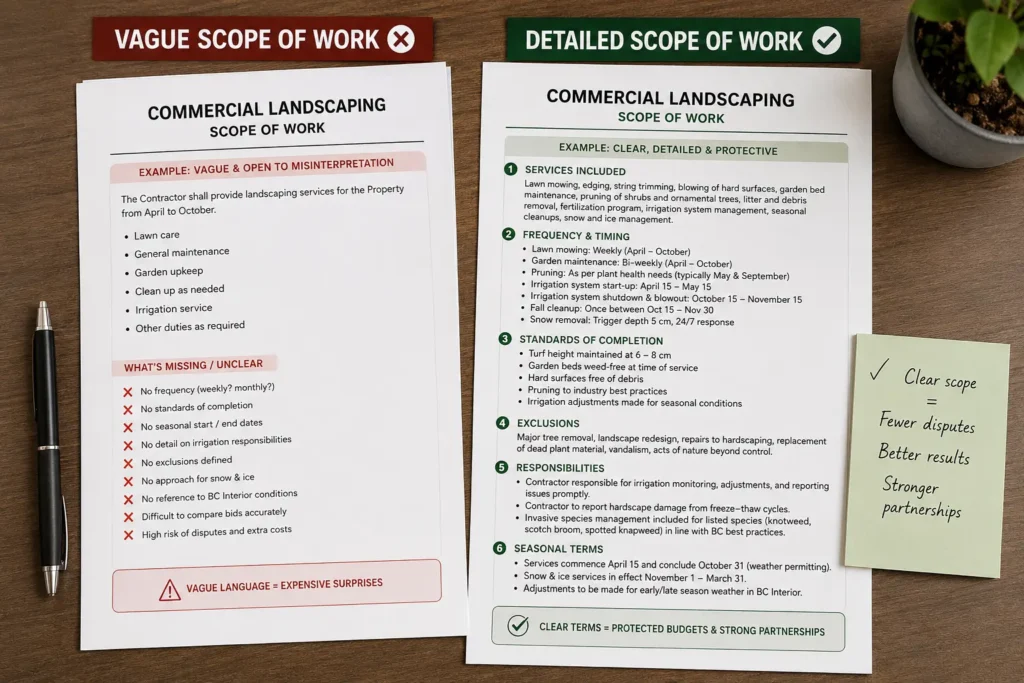
A scope of work isn’t the contract itself — it’s the technical backbone that sits inside your contract. It’s the section that answers: What exactly are you paying for? A contract without a detailed scope is basically a promise without a plan.
In commercial landscaping, a proper scope of work will typically outline:
- Services included — lawn mowing, edging, fertilization, irrigation system management, pruning, litter pickup, seasonal cleanups, snow removal, and so on
- Frequency — weekly? Bi-weekly? Monthly? After every snowfall above 5 cm?
- Standards of completion — turf height maintained between 6–8 cm, beds free of weeds at time of service, etc.
- Exclusions — what the contractor is explicitly not responsible for
- Seasonal start/end dates — especially important in BC’s Interior where spring can arrive in March in Kamloops but not until May at higher elevations
- Responsibility for plant material — if a shrub dies, who replaces it and at whose cost?
The more specific this section is, the fewer disputes you’ll have. It’s also what allows you to compare bids properly — if Contractor A includes spring aeration and Contractor B doesn’t, you need to know that before you make a decision based on price alone.
BC Interior Conditions That Must Be Addressed Explicitly in Your Scope
Here’s where generic contract templates — the ones you download from a Google search — fall flat in BC’s Interior. Our climate is not the Lower Mainland’s climate. Kamloops, Kelowna, Merritt, and surrounding areas deal with conditions that need to be named in your scope, not assumed.
Dry summers and irrigation management: The BC Interior routinely sees stretches of 35°C+ heat with no rain for weeks. Your scope needs to specify who’s responsible for irrigation scheduling adjustments, who handles spring startup and fall blowouts, and what happens if a zone fails mid-July. Leaving this undefined is an invitation for a dead boulevard and a billing dispute.
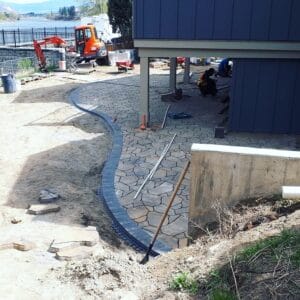
Freeze-thaw cycles and hardscape damage: A late October frost followed by a warm spell followed by hard freeze is completely normal in Kamloops. If you have concrete edging, paving stones, or retaining walls, your scope should address who reports frost heave or cracking — and whether the landscaper is responsible for minor repairs or just flagging issues to the property manager.
Invasive species: Japanese knotweed, Scotch broom, and spotted knapweed are genuine problems across the BC Interior. If your property has a history with invasive plants, your scope should explicitly state whether invasive management is included, what methods are approved, and how disposal is handled. BC’s Invasive Species Council recommends a management plan — your landscaping contractor should be aligned with that plan, not working around it.
Snow and ice management: If your commercial property requires year-round care, snow removal terms need to be in their own clearly defined section. Trigger depths, sanding schedules, liability for slip-and-fall incidents during service windows — all of it needs to be spelled out. Lumping snow removal into a general maintenance clause is one of the fastest ways to create a dispute in February.
For a deeper look at what strata councils specifically need to address before hiring a commercial landscaper, we’d recommend reading our post on what strata councils in BC need to know before hiring a commercial landscaper — it covers the governance side of this in more detail.
The Sections Every Commercial Landscaping Scope of Work Should Include
Let’s get practical. Here’s a breakdown of the major sections a solid scope of work should contain for any commercial property in BC:
1. Property Description and Site Map
Include a simple site map or property description that outlines the areas covered. Specify square footage of turf areas, number of trees and shrubs included, linear metres of bed edging, and any areas explicitly excluded (e.g., a private courtyard, rooftop garden, or area under a separate contract). Sounds basic, but we’ve seen contracts that don’t even identify which property they’re for beyond a street address.
2. Service Schedule with Frequencies
List every service and how often it’s performed. “Lawn mowing” isn’t enough. It should read more like: Turf areas mowed to a maintained height of 6–8 cm, weekly from May 1 through September 30, bi-weekly in April and October, with clippings mulched or removed per site agreement. That’s the level of detail that prevents arguments.
3. Seasonal Service Events
Define what happens at key seasonal transitions — spring cleanup, fall cleanup, irrigation startup/shutdown, mulch refresh, winterization of plantings. BC Interior properties need mulching around trees and shrubs before freeze-up (typically late October in Kamloops). If that’s not in the scope, it probably won’t happen — or it’ll show up as a change order invoice in November.
4. Plant Health and Replacement Policy
Who is responsible if a plant dies? What’s the warranty on new plant material? If the landscaper installs seasonal annuals and a late frost hits in May — not unusual in the BC Interior — is replacement included? These are the questions that blow up commercial relationships if they’re not answered in advance. Our team is firm on this one: if we install it, we stand behind it for the growing season, provided irrigation is adequate and the scope includes appropriate care. But that needs to be in writing.
5. Exclusions and Change Order Process
Be explicit about what’s not included. Tree removal, major irrigation repairs, hardscape installation, pest treatment — if it’s not in scope, say so. And include a simple process for how out-of-scope work gets approved and priced so that neither party is surprised when something extra comes up.
6. Performance Standards and Inspection Rights
How will you know if the work is being done to standard? Include language that describes acceptable completion criteria and give the property manager or strata council the right to request a performance review or site walk. This keeps everyone accountable — and it gives the contractor a clear target to hit.
How to Use Your Scope of Work to Compare Bids Fairly
One of the most underrated uses of a detailed scope of work is in the bidding process itself. If you send the same scope to three different commercial landscaping companies and ask for itemized quotes against it, you get a genuinely comparable set of numbers. You can see exactly where one company is cutting costs, what add-ons each one is proposing, and whether any of them are flagging risks or gaps you hadn’t considered.
When bids come back wildly different — and they often do — a detailed scope tells you why. Maybe one contractor is using cheaper annual plant material. Maybe another is pricing irrigation startup separately. Maybe one is the only company that actually included invasive species monitoring. Without a detailed scope, you’re comparing apples to chainsaws.
We’d also strongly encourage property owners to ask bidding contractors to flag anything in the scope they think is missing, unrealistic, or priced incorrectly. A contractor who reviews your scope carefully and comes back with thoughtful questions is almost always a better long-term partner than one who just signs and sends a low number.
For larger commercial properties in BC — particularly those involving civil grading, drainage, or significant construction work alongside ongoing maintenance — it’s also worth reviewing how site grading in BC can affect long-term maintenance costs. Drainage problems that aren’t addressed at the construction phase routinely become landscape maintenance nightmares that show up in your contract as recurring line items.
Red Flags to Watch for When Reviewing a Contractor’s Proposed Scope
Not all commercial landscaping contracts are written by the property owner. Sometimes the contractor sends you their standard agreement and asks you to sign. Here’s what to watch out for:
- “As needed” or “as required” without a definition of what triggers that service. This phrase should be treated like a warning label. It means nothing unless it’s tied to a specific condition (e.g., “litter pickup as required, minimum twice per week during service visits”).
- No exclusions list. If a contract doesn’t say what’s excluded, both parties are going to interpret that silence differently — and that always costs someone money.
- Vague seasonal language. “Spring and fall cleanups included” with no definition of what that means, when they happen, or what standard they’re completed to is not a scope — it’s a suggestion.
- No plant material warranty or replacement terms. Especially important for properties with significant horticultural investment.
- No escalation or review process. Multi-year contracts should include a mechanism for reviewing scope and pricing annually, particularly given fuel and labour cost changes in BC over recent years.
Our approach at Lyons Landscaping is to work through a scope of work collaboratively with commercial clients before a contract is ever signed. We’d rather spend an extra hour getting the details right upfront than spend three hours on a dispute mid-season — and so would you.
Conclusion: A Detailed Scope Isn’t Bureaucracy — It’s Protection
Writing a thorough commercial landscaping scope of work for your BC property isn’t about distrust. It’s about clarity. When both parties know exactly what’s expected, what’s included, and what falls outside the contract, the working relationship is actually easier — not harder. Crews know what they’re showing up to do. Property managers know what to inspect. Strata councils can report to owners with confidence.
The properties we see running smoothest, year after year, are the ones where the scope of work was treated as a living document — something that gets reviewed, updated, and refined each season based on what worked and what didn’t.
If you’re putting together a commercial landscaping agreement for a property in Kamloops, Kelowna, or anywhere in the BC Interior and you’re not sure where to start, we’re happy to help. We’ve been doing this long enough to know what gets left out, what causes disputes, and what a contract needs to actually protect a BC property through all four seasons.
Contact Lyons Landscaping today for a free consultation — we’ll help you build a scope of work that actually works, or review an existing contract before you sign it.