
The most expensive part of landscaping is time lost to delays, rework, and poor coordination.
In construction, time itself isn’t a material — but it directly controls cost. When landscaping is delayed, the impact spreads across the entire project. Interest costs increase. Occupancy gets pushed back. Revenue is delayed. Pressure builds for owners, developers, and general contractors.
At Lyons Landscaping, we see this every day on commercial and large-scale projects. Landscaping rarely becomes expensive because of plants or materials alone. It becomes expensive when it slows the project down.
Why Landscaping Costs Escalate
Most people assume landscaping costs come from:
- Mature trees
- Hardscape materials
- Irrigation systems
- Labor
Those items matter, but they are usually predictable.
What drives real cost overruns is:
- Delayed schedules
- Rework caused by early planning gaps
- Poor coordination between trades
- Late design changes
- Waiting on plant material or approvals
Once landscaping becomes a critical path item, every lost day costs money.
The Real Problem: Fragmented Landscaping Delivery
On many projects, landscaping is split across multiple companies:
- One firm handles civil excavation
- Another does design
- Another installs irrigation
- Another supplies plants
- Another maintains the site
That can mean coordinating six or seven different trades, each with their own contracts, timelines, and priorities.
When something goes wrong, responsibility gets blurred. Decisions slow down. Work stops. Delays compound.
This is where landscaping quietly becomes one of the most expensive parts of a project.
How Lyons Reduces Cost by Reducing Delay
At Lyons, we operate under a fully integrated model:
Design. Build. Maintain.
Not as a marketing phrase — but as the way we run projects.
We act as a single point of responsibility for:
- Civil excavation and site preparation
- Landscape architecture
- Landscape construction
- Irrigation
- Plant supply
- Long-term maintenance
One team. One schedule. One standard.
This integrated structure removes handoffs, shortens decision-making, and keeps projects moving when conditions change. Explore our integrated commercial landscaping approach.
Experience on Site: Getting It Right From the Start
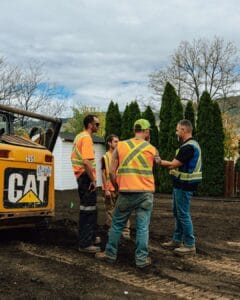
Because Lyons is involved from the civil excavation and site preparation stage, the site is shaped correctly from day one.
Grades, drainage, access, and infrastructure are planned with the finished landscape already in mind. This prevents the common — and costly — scenario where landscaping reveals problems that should have been solved earlier.
Issues with grading and drainage are among the most common causes of rework when landscaping is introduced too late in the construction process. We regularly see projects lose weeks correcting grading, drainage, or access issues that could have been avoided with early coordination.
In-House Design Prevents Stalled Projects
One of the biggest advantages of our model is our in-house Landscape Architectural division.
When site conditions change:
- Design adjustments don’t sit in email chains
- Crews don’t wait on third-party consultants
- Decisions happen in real time
Changes are made in hours, not days or weeks. That keeps labor productive and schedules intact.
Plant Availability Is a Major Source of Delay
Plant supply is one of the most underestimated causes of landscaping delays.
Designs are approved, then materials can’t be sourced. Substitutions trigger redesigns. Installation pauses.
With our own garden center and plant supply, Lyons can confirm availability during design and immediately adjust when conditions change. This avoids last-minute substitutions and removes weeks of uncertainty from the schedule.
What This Looks Like in Practice
By integrating design, construction, and maintenance under one roof, Lyons consistently reduces overall build timelines by at least six weeks.
That translates directly into:
- Lower construction interest costs
- Faster occupancy
- Earlier revenue generation
- Fewer schedule conflicts
Landscaping stops being a bottleneck and becomes a controlled part of the build.
Maintenance Is Part of the Plan — Not an Afterthought
Because we maintain what we build, landscapes are designed and installed for long-term performance.
Access, plant selection, irrigation layout, and durability are all considered upfront. This protects the investment long after construction is complete and avoids costly fixes down the road.
Final Answer: What Is the Most Expensive Part of Landscaping?
The most expensive part of landscaping is the cost created by delay — not the landscape itself.
When landscaping is fragmented, reactive, or brought in too late, costs rise quickly. When it’s integrated, planned early, and owned by one accountable team, timelines shrink and total project cost drops.
That’s how Lyons Landscaping approaches every project — and why our clients see faster builds, fewer issues, and better long-term results.