Key Takeaways
- Proper site grading in BC is the single most critical step before any landscaping begins — skipping it costs far more in repairs later.
- BC Interior conditions — including clay-heavy soils, freeze-thaw cycles, and intense spring runoff — make grading more complex than in milder climates.
- The standard minimum slope away from any structure is 2% over the first 3 metres, but BC Interior conditions often demand more.
- Poor drainage is the number-one cause of premature hardscape failure, foundation damage, and dead landscaping on properties we’ve assessed across Kamloops and the surrounding region.
- Getting grading right the first time is always cheaper than fixing it after your patio, retaining wall, or sod installation is already in place.
Introduction: The Work You Don’t See Is the Work That Matters Most
Most homeowners want to jump straight to the fun stuff — the patio pavers, the raised garden beds, the new lawn. And honestly, we get it. That’s the part you’ll actually see and enjoy every day. But here at Lyons Landscaping, after years of working across Kamloops, the BC Interior, and beyond, we’ve watched too many beautiful landscaping projects fail within a few seasons because nobody paid attention to what happened before the plants went in the ground.
Site grading BC properties correctly isn’t glamorous. You won’t Instagram it. But it is the foundation — literally and figuratively — of every outdoor project we take on. Whether we’re reshaping a residential backyard in Brocklehurst, preparing a large commercial site in Kelowna, or handling civil work for a new development, lot grading is always where the real conversation starts. The grading considerations for commercial sites can differ from residential work, since scale, drainage volume, and site use all change the equation. Get it wrong, and everything built on top of it is just waiting to fail.
What Is Site Grading, and Why Does It Matter in BC?
Site grading is the process of reshaping the land — cutting here, filling there — to establish a slope that moves water away from structures and toward appropriate drainage points. It’s not just “levelling” your yard. In fact, a perfectly flat yard is almost always a problem. Water needs somewhere to go, and your job (or rather, our job) is to tell it exactly where that is before it decides on its own — usually toward your foundation, your neighbour’s fence, or straight into your crawlspace.
In BC’s Interior, this matters more than in many other parts of Canada. Kamloops and the surrounding region deal with a unique combination of challenges: hard-baked, compacted clay soils that don’t absorb water quickly, intense spring snowmelt that can dump significant runoff in a short window, and freeze-thaw cycles through late fall and early spring that shift soil and undermine grades that weren’t established properly to begin with. According to the BC Government’s integrated flood hazard management guidelines, improper drainage on residential and commercial lots is a significant contributor to localized flooding and property damage across the province.
The standard residential grading requirement is a minimum 2% slope (roughly 2 cm of drop per metre) away from all structures over the first 3 metres. In practice, for BC Interior conditions, we often recommend pushing closer to 3–5% wherever the soil type or site layout allows it. Clay-dominant yards in Kamloops, for example, shed water slowly even with a good grade — so giving yourself extra margin isn’t overcautious. It’s just smart.
What Happens When Grading Is Done Wrong (Or Not Done at All)
We’ve seen this play out dozens of times, and it never gets less frustrating — for us or for the homeowner. Picture this: a client in Sahali spends $30,000 on a beautifully designed backyard. New sod, a concrete patio, a retaining wall, the works. Two years later, they’re calling us because the patio is heaving, the retaining wall is leaning, and there’s a soggy, dead patch of lawn that won’t drain no matter what they try. When we dig in (sometimes literally), the cause is almost always the same: nobody properly graded the site before the project started.
Poor grading creates a cascade of problems that compound over time. Water pooling near a foundation doesn’t just stay there — it works its way into cracks, freezes in winter, expands, and slowly damages your structure. Retaining walls without proper drainage behind them build up hydrostatic pressure until they bow or fail. Sod laid over improperly graded fill soil will die in low spots where water sits too long, and in BC Interior summers, those same low spots will bake into hardpan if they do dry out. It’s a clear example of grading’s direct role in drainage performance — when the slope is wrong, water has nowhere safe to go, and the damage tends to show up first during the wet fall and winter months.
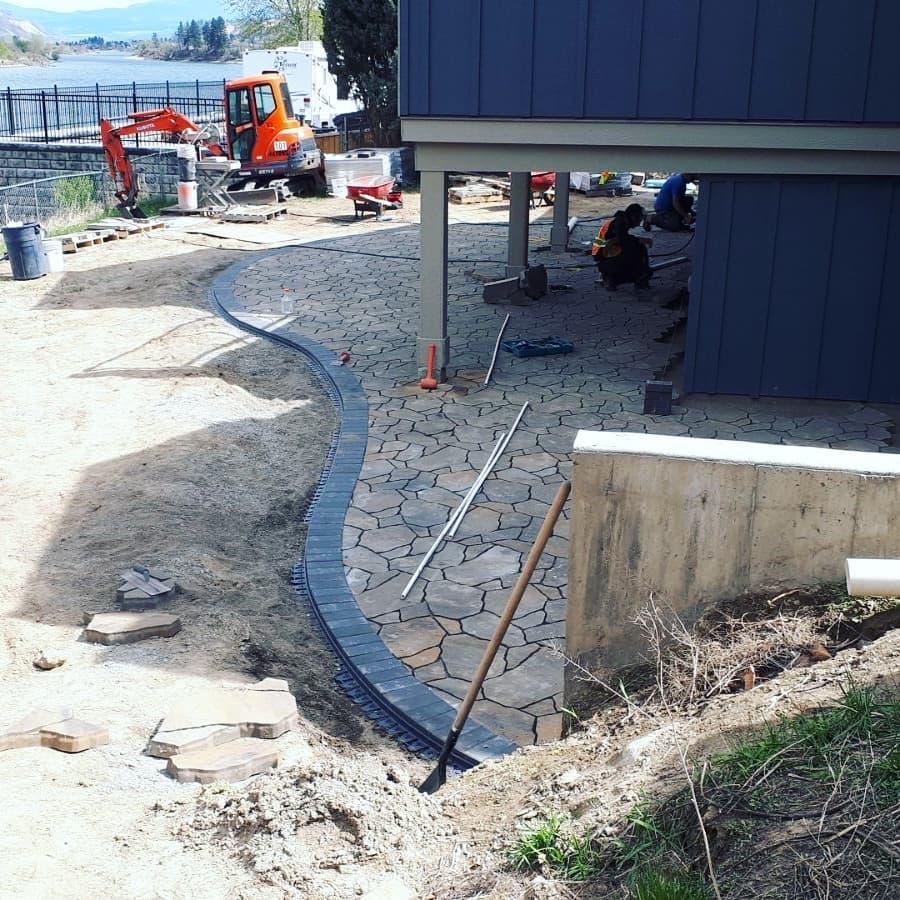
Hardscape failure is especially costly. Concrete, interlocking pavers, and natural stone all move when the ground beneath them shifts — and improperly graded soil that holds water through freeze-thaw cycles is almost guaranteed to shift. We’ve seen beautifully installed patios reduced to a jigsaw puzzle of lifted and cracked stones within three winters. The repair bill is always significantly higher than the grading work would have cost upfront. Always.
If you’re not sure whether your contractor has the experience to handle this properly, our post on 10 Questions to Ask Before Hiring a Landscaper is worth reading before you sign anything.
BC Interior Soil Conditions: Why One-Size Grading Doesn’t Work Here
Here’s something a lot of generic landscaping advice gets wrong: grading recommendations that work fine in Vancouver’s sandy loam coastal soils don’t necessarily translate to what we deal with in the Interior. Kamloops sits in a semi-arid climate zone with soils that range from silty clay near the Thompson River corridor to rocky, compacted fill in newer subdivisions built on former benchland. These soils behave very differently under load, during rainfall, and during freeze-thaw cycles.
Clay soils, which are common across much of the Kamloops basin, expand when wet and shrink when dry. In a hot Interior summer, the top 30–50 cm of clay soil can pull away from foundations and retaining structures as it desiccates — then swell back against them during fall rains and spring melt. If your grading doesn’t account for this, you’re essentially letting the soil do whatever it wants to your landscape infrastructure. The Natural Resources Canada soil classification resources provide a useful technical foundation for understanding regional soil variability, but the real-world application requires someone who has actually worked these soils across multiple seasons.
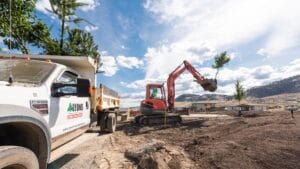
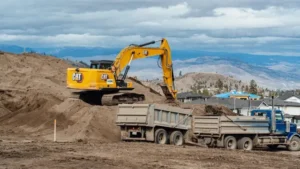
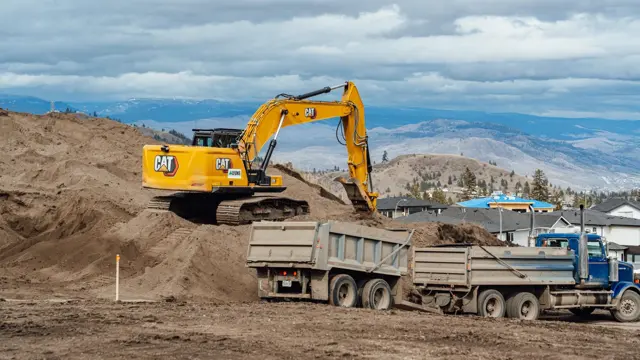
Rocky fill sites — which we see frequently on newer subdivisions around Kamloops and in communities like Chase and Barriere — present a different challenge. Compaction is uneven, settlement is unpredictable, and getting proper drainage established through rocky substrate often requires engineered drainage solutions rather than simple surface grading. Our civil excavation and trucking services are specifically equipped to handle this kind of site work, from initial assessment through to final grade establishment and drainage infrastructure. Once the grade is established, the next stage often involves digging for drains or utilities, and trench safety once grading is complete becomes just as important to get right.
How We Approach Site Grading at Lyons Landscaping
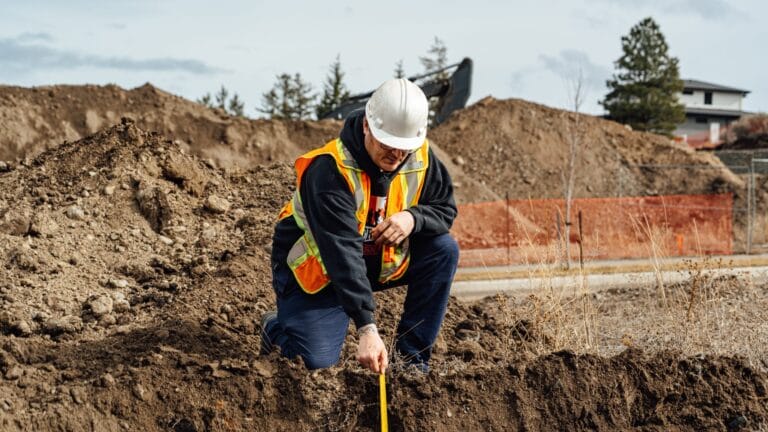
Our approach isn’t complicated, but it is thorough. Before any grading work starts, we assess the existing topography, identify where water currently flows (and where it pools), evaluate the soil type, check for any utility conflicts, and figure out what the finished grade needs to achieve — not just for drainage, but for the landscaping plan that follows. Grading doesn’t happen in isolation from the rest of the project. It informs everything.
On a recent residential project in Westsyde, we took on a property where a previous contractor had actually graded the yard toward the house — a surprisingly common mistake on sloped lots where the installer was trying to level a patio area without thinking about the broader water flow. The client had been dealing with a persistently damp crawlspace for two years. We regraded the entire backyard quadrant, installed a subsurface French drain system to handle the clay soil’s slow absorption rate, and established a positive slope to a purpose-built dry well at the far end of the property. The crawlspace issue resolved itself within the first season.
Our honest take? Grade establishment should never be an afterthought or a line item that gets cut to save money. It is the single highest-value investment you can make in a landscaping project, because everything else depends on it. A well-graded site protects your foundation, extends the life of your hardscape, keeps your lawn and plantings healthier, and reduces ongoing maintenance costs. If a landscaping quote you’ve received doesn’t include a grading assessment, ask why. The answer will tell you a lot about the contractor you’re dealing with. For more on what a thoughtful landscaping process looks like from the ground up, see our post on What Does a Landscape Designer Do? — grading assessment is always part of the design conversation we have with clients.
When to Grade: Timing Matters in BC’s Interior Climate
Timing your site grading work correctly in BC’s Interior is something that separates a contractor who knows the region from one who doesn’t. The ideal window for grading in the Kamloops area is generally late spring through early fall — after the ground has fully thawed and dried enough to work, but before the fall rains make the clay-heavy soils unworkable and prone to compaction under equipment. That typically means late April through September, depending on the year.
Grading in wet conditions is a real problem with clay soils. Equipment working over saturated clay creates deep ruts, compacts the subsoil beyond what’s healthy for plant establishment, and produces a smeared, impermeable layer at the base of the disturbed zone that actually worsens drainage long-term. We’ve turned down grading jobs because the ground wasn’t ready — not because we didn’t want the work, but because doing it badly would have cost the client more in the long run.
Fall grading is sometimes necessary — particularly for new construction projects where the schedule is set by the builder, not the weather. In those cases, we adjust our approach: working in shorter windows when conditions allow, protecting freshly graded areas from erosion before winter sets in using erosion control fabric or temporary seeding, and revisiting the grade in spring to correct any frost heave before final landscaping begins. The point is that grading in BC’s Interior requires reading the conditions, not just following a calendar.
Conclusion: Don’t Build on a Problem You Could Have Prevented
Proper site grading isn’t the most exciting part of a landscaping project — we’ll be the first to admit that. But it is the most consequential. Everything you build, plant, or pave on top of your property will perform better and last longer if the ground beneath it is properly shaped to move water where you want it to go. In the BC Interior, with our clay soils, freeze-thaw cycles, and intense spring runoff, getting the grade right isn’t optional. It’s the whole game.
At Lyons Landscaping, we’ve built our reputation across Kamloops and the BC Interior on doing this kind of foundational work properly — even when it’s the part of the job no one photographs. If you’re planning a new landscaping project and want to start it on solid footing (literally), we’d love to talk through your site with you.
Contact Lyons Landscaping today for a free site assessment and estimate. We’ll make sure your property is graded right before anything else goes in the ground.